AI's impact on the mental health of the industry - Part 4
What’s actually working?
AI is helping with the mundane, the repetitive, and the early-stage – freeing people up for higher-value creative thinking.
“Feels like early Christmas... today, it feels that we have so many tools to play with.”
Female, Hispanic, 35-44
KEY DATA
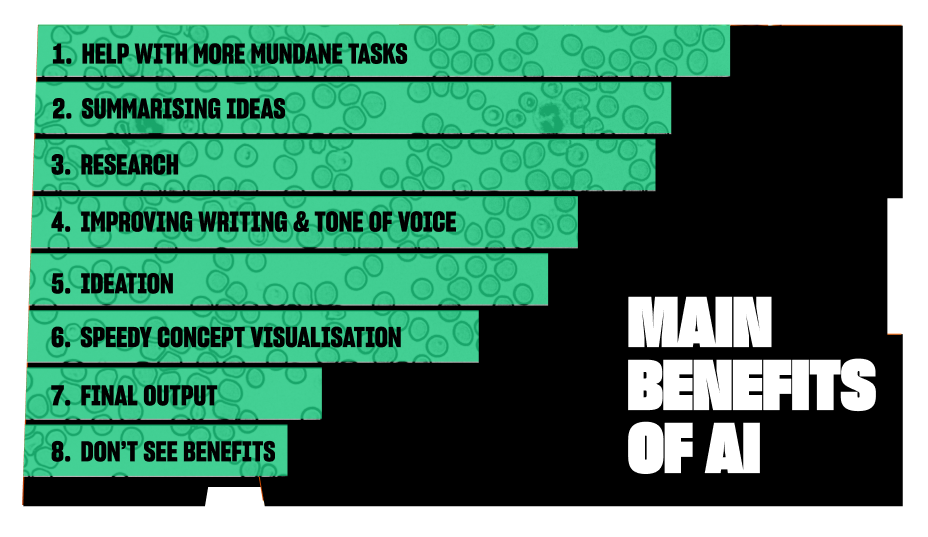
• Almost ¾ of people surveyed use AI every day or a few times a week.
• Top 3 cited benefits: help with mundane tasks, summarising ideas, research.
• Closely followed by: improving writing/tone, and ideation.
• “I don’t see any benefits” ranked as the lowest selection on the list.
• AI is being used effectively at multiple steps in the creative process, particularly during pitching and ideation.
• Skepticism remains around use for final output, but earlier stages are embraced.
It’s important to recognise that this narrative does not have to be doom and gloom. Things are moving so fast that the script is not already written, and is certainly nowhere near finished. There is hope, there is optimism, there’s even excitement. It seems the best way to find it, is to scratch the curiosity itch and discover what’s possible.
AI is genuinely helping many people in our industry. Almost ¾ of people surveyed are using AI everyday or a few times a week. The top 3 benefits being cited as, “help with more mundane tasks,” “summarising ideas” and, “research.” These are closely followed by “improving writing and tone,” and “ideation.” It was also encouraging to see the answer, “I don’t see any benefits” ranked as the lowest selection on the list.
While the skepticism around AI for final output was strong, it’s clearly being used efficiently and effectively at different points and levels throughout other steps in the creative process. In more than one conversation with an agency leader that I’ve had recently, AI is rapidly reinventing the concept phase of creative work during pitching and ideation.
This article on the World Economic Forum website, points to the need, but also human opportunity to shape the future of a world with AI.
“If we use AI creatively, we can do much more than just generate text and images – we can drive social value and innovation. This field is still untapped, and creatives are well-positioned to lead this change.”
Is that not what we love to do?
And in our study, this participant shared,
“I am quite enthused about the counter to AI in creative industries. Examples like stop-motion animation. The AppleTV ident, which was done with real-world practical effects.The Ying of AI should have its yang. If it means that there will be an opposite to 'faster, smarter AI' - more human creativity, then that is an unexpected upside.”
While this participant summed up almost perfectly the positive opportunities ahead.
“Boosting creative confidence. AI is not going away. Positioning it as something to be fearful of puts people into freeze states, and a sense of hopelessness and helplessness. Right now, we need humans to see the good and possible.”
This is the end of our preview of the final research report. It will be released shortly.
What's been clear from our findings and from our community taking the time to share their thoughts and their opinions, is that this is clearly a pivot moment for our industry. Business models will be challenged, along with the creative process, the perspective of what's creative and what isn't, and how much any of this is worth.
The final piece of our research focused on how we as a charity for the industry can help. You can read more on that in the report, but expect sharing of best practices, appropriate support and lobbying where we can for ethical and responsible use of AI in our work.
Thanks for reading along, and if you'd like to take part in the discussion, join our Slack community.
Go back and read
Written by Kate Shelton and Andy Wright.
Discuss the findings over in Slack.