AI's impact on the mental health of the industry - Part 3
The Human Cost: Work being devalued and ethical concerns top the list – this industry cares deeply about the value of creativity.
“That our industry will be so devalued it will be impossible to continue to run a business, clients will take everything in house with cheaper resources”
Female, 35-44, Australia
KEY CONCERNS
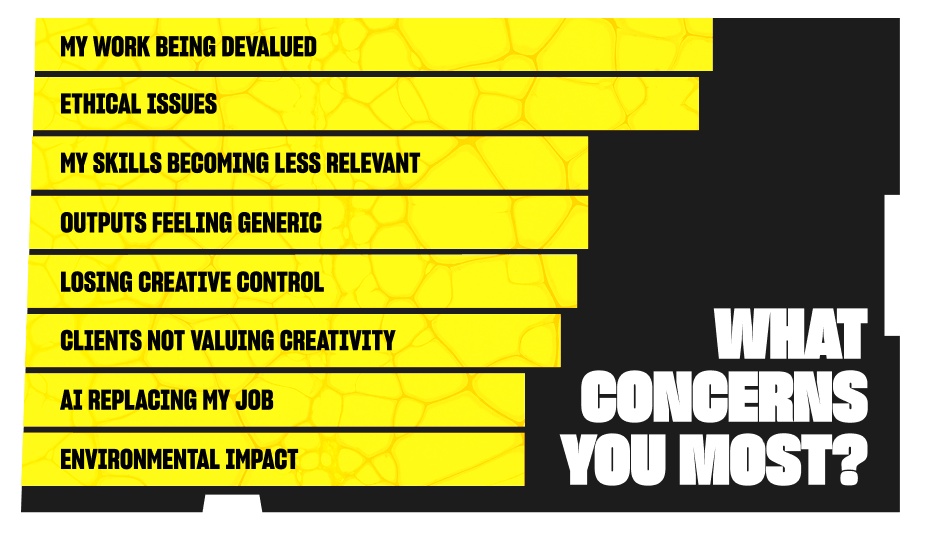
#1: “My work being devalued” (rated 9.1/10 overall; 9.52 men, 8.72 women).
#2: Ethical issues (stolen data, copyright).
#3: My skills becoming less relevant.
#4: AI outputs feeling generic or inauthentic.
#5: Losing creative control.
#7: AI replacing my job — consistent across age groups and workplace types.
• 18–34 year olds rank ethical issues as their #1 concern (vs devaluation for 35+).
• Client-side workers mirror younger cohorts: ethical issues top their list too.
To say our industry is worried about AI is to take a shallow view of what the real issues are. The key question that allows us to unpack what’s keeping us up at night was “what concerns you most about the use of AI at work?
Our analysis quickly uncovered a top 5. The top 2 selected concerns were, “my work being devalued” and, “ethical issues, e.g. stolen data, copyright.” These 2 were clear of the chasing pack and reaffirmed our industry’s care and thoughtfulness for the value of creativity.
Next, was “my skills becoming less relevant;” in line with what we’re being told by AI advocates, business and mainstream media. It is indeed a scary thought to be confronted with everyone telling you that you’re no longer needed. Even with technological advances throughout history, machines have leaped ahead, but have still required significant human involvement in operation and direction of the output. With AI the story is one of not machine replacing machine, but machine replacing human. Even if the story isn’t that desperate, it also tracks with the 5th placed concern, “losing creative control.”
In between at number 4 is the critique of “AI outputs feeling generic or authentic.” It’s true that at the time of our research being in market, many of us would feel that we could “spot a fake.” However, even since then, and with the rapid advancement of the technology, that’s certainly becoming harder and harder. The University of New South Wales’ research into face recognition of AI generated images is a fascinating test of our abilities as well as shared understanding of how AI is learning to re-create real life.
The concern, “AI replacing my job,” came in at number 7 overall and was at a consistent level across age groups and other segments we analysed like in-house vs agency.
As we dug deeper, we found some differences in what was concerning depending on who you are. For example, while the top 5 were the same for most of our respondents, we noticed differences in 18-34 year olds. Their top concern was “ethical issues”, while “my work being devalued” remained number 1 for those over 35. This same difference was mirrored for those working client-side (ethical issues) vs agency.
So, how much are our concerns driven by intrinsic or extrinsic factors?
The stressor that nobody named a few years ago.
For the first time, AI-related uncertainty has broken into the top 5 industry stressors, reshuffling a list that’s been consistent since 2018.
“Everyone laughs nervously at work saying they don’t know if they’ll have a job in the next 3 years.”
Male, caucasian, 45-54
KEY DATA
• “Pressure of my own expectations” remains #1 (as it has since 2018).
• NEW at #2: “Uncertainty regarding the future of my role” — has never placed this high before.
• NEW at #4: “Pressure to stay up to speed on trends and technology, like AI.”
• 44% have been diagnosed with a mental illness at some point; 23% with a neurodiverse condition.
• ~60% experienced burnout in the last 12 months, down from 70% in the 2024 survey.
• Key insight: those who had NOT experienced burnout were more likely to be using AI every day.
• Non-burnout respondents valued “staying adaptable to AI developments” much higher than the survey average.
We’ve been measuring the industry’s experiences and challenges with mental health since 2018. In every one of our studies, one of our foundational questions has been to help us understand the relative levels of stress associated with different dynamics within the industry.
Every study has consistently placed the pressure of our own expectations at number one. The overall top 5 had remained stable, until now.
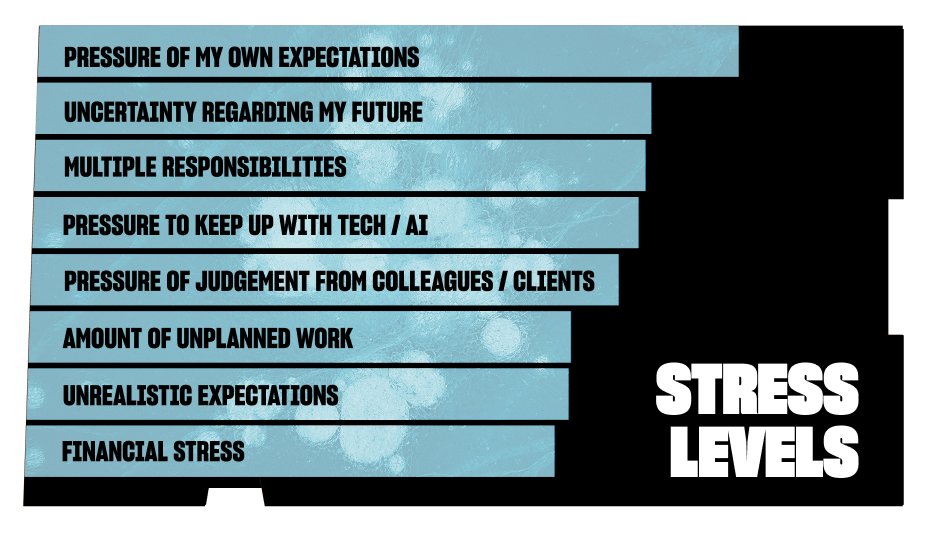
The top 5 has been cracked open, and AI has asserted its presence. At number 2 is “uncertainty regarding the future of my role” and at number 4, “pressure to stay up to speed on trends and technology, like AI.” Both reflecting the turbulence and uncertainty we’re currently facing.
As context to these findings, we also asked about overall levels of mental wellbeing. 44% shared that they have been diagnosed with a mental illness at some point, with 23% having been diagnosed with a neurodiverse condition. The number of people who shared they experienced burnout in the last 12 months was at just under 60%, down from 70% in our 2024 survey.
As we dove further into burnout though, we found one of this study's most interesting insights. If you ‘had not’ experienced burnout in the last 12 months, you were more likely to be using AI everyday in your work.
Here’s what people in this segment shared about their experiences.
“I’m optimistic about AI as a creative partner because it expands what’s possible in my workflow. It allows me to prototype ideas faster, explore more directions, and add powerful new capabilities to my toolkit. I’ve always been a tech optimist and adopt new tools, and AI fits naturally into that mindset. For me, it’s not about replacing creativity but amplifying it, giving me more space to focus on insight, craft, and high-value thinking.”
“AI is a tool that accelerates execution. As a Creative Director it gives me superpowers.”
“I am optimistic about the things it allows us to do and increase my ability to deliver more, I am concerned about the loss of jobs and potential to increase in-housing.”
We also found that they viewed one of the top skills for the future to be staying adaptable to developments with AI, valuing this much higher than the survey average. This seems consistent with conversations with other creatives and leaders in the space. While the future may be uncertain, we can choose to keep it at arms length, or we can choose to lean-in, learn and make it a less scary unknown. Better to assert control and gain understanding, than to give in to the fear and doom-mongering; much, the same way that this industry has survived in the past, by embracing change and opportunity. As the respondent below, shared;
“I'm optimistic that it'll change how we work, we might get to discover new things we hadn't thought of or free up our time for the more exciting conceptual parts of the job. The world is pushing this upon us whether we like it or not, it's important we come to the table so we can have a say in how it's used in our industry and how we can make it work for us, not against us.”
The push back: Respondents shared why they’ve turned down AI. Their reasons reveal values, not stubbornness.
“I told them I was hired for my creativity and that is also why clients come to us.”
25-34, Female, Caucasian, Australia
KEY DATA
• 66 respondents described turning down an AI tool they were asked to use.
• Top 5 themes: creative identity & skill, ethical/environmental concerns, low quality, irrelevance to the task, bad experience.
• AI is being reached for in mundane tasks (summarising, research, grunt work) rather than final output or asset production.
• In a rapidly evolving space, some concerns will solidify (ethics, environment) while others may fade (bad experience, quality).
In any age of “disruption” (dare we use the word!) there are always some who choose to stand against the tide of change. From marching or shouting in the streets to quietly quitting or rebelling in smaller, more personal ways.
In the case of AI, the pushback within the creative industries is rooted in a feeling that AI threatens the very things we hold dear: creativity, originality, human truth.
When asked, “Have you ever turned down using an AI tool you were requested to use, and why?”, we captured 66 responses.
Why people are saying no:
- Creative identity & skill
“I can think for myself, I want to be a human, not a cog”
“If we start outsourcing creativity to AI, then why would clients come to us?”
“I want to come to a solution through my own discovery path of educating myself on the problem and exploring solutions. It is in the grey area that exciting thoughts percolate and rise to the top.”
- Ethical, social and environmental concerns
“Added no value and the environmental impact and unknown copyright issues made it not worth it”
“I don't want to contribute to the environmental impacts associated with AI (energy use, water use, mineral mining…)”
- Low or varied quality
“The output quality was exceptionally bad”
“Our Marketing department was given a rebadged ChatGPT product to use to do creative, write briefs and do strategy. It sucked. I used it and then gave up because it was no better than Copilot. I've told them I'm no longer using it.”
- Relevance to the task isn’t always there
“I don’t enjoy using it. I don’t find it gives me the outcome I want or a unique perspective. I find it’s generic and the same thing is spurted out to everyone”
“It was ineffective at the task it was made to do. I will not use something purely because it's AI.”
- Bad experience
“The output wasn't functional for our needs. In one particular instance we required illustrations that were layered in preparation for animation. The output from the AI tools we were using at the time were flat.”
“It didn't deliver the results my manager was looking for”
Go back and read
Written by Kate Shelton and Andy Wright.
Discuss the findings over in Slack.