AI's impact on the mental health of the industry - Part 1
Welcome to the first in a 4 part blog series reviewing our research into the impact AI is having on the industries mental health.
AI’s rapid rise in the creative industry prompted us to look beyond the commercial impact and ask:
What is it doing to our mental health?
“It has the capacity for greatness, but its capacity for evil is what scares me. I hope we emerge on the other side.“
Female, caucasian, 25-34, Australia
KEY DATA
• The #1 concern in this industry is AI’s effect on the devaluation of creative work (rated 9.1/10).
• Job uncertainty has risen to the #2 stressor — higher than in any previous study.
• Curiosity is the primary driver of AI adoption (49%), though pressure from clients, managers and peers is mounting.
• Higher AI usage correlates with lower experiences of burnout.
• Concern about AI is consistent regardless of age, gender, or workplace type — though what people are concerned about varies.
• 80% have experimented with AI and found it useful.
The impetus for this research wasn’t the commercial reality of AI. It was the inevitable effect on mental health for people who count this industry as their passion and their means of living, progressing, and putting food on the table.
On one hand, AI is innovation, an opportunity; for the most curious of us, a chance to jump on board and ride fast-forward into the future. For others, it’s anxiety creating, catastrophising, end of days depressing, and sometimes both at the same time.
We’ve read about the disruption to business models, workflows, creativity and output. But, we haven’t heard enough about the emotional stakes. We haven’t seen the inside narrative. What it’s doing to our brains, our confidence, our hope and our individual and collective mental health.
If you’re new to Never Not Creative, well, this is what we do. We’re a charity setup to look out for everyone working in this industry. We shine a light on the challenges, the stressors, the things that bring us joy and the things that bring us crippling imposter-syndrome and everything in-between.
Rather than ‘wait-and-see’ what happens, we decided to get a lay of the land on where we’re at right now, and ask the question, what can we do to help?
Who we heard from
206 voices from across the creative industry gave us a representative snapshot of who we are and what we’re thinking.
KEY DATA
• 206 respondents captured over 3 months (Oct 2025 – Jan 2026), 165 completed in full.
• Largest age group: 35–44, with representation from 18–24 through to 55+.
• 80% Australia-based, with additional voices from UK, US, New Zealand and Europe.
• Just under 60% female; majority Caucasian, with representation across Asian, Indian, Hispanic and other backgrounds.
• Most common workplaces: creative agencies, design studios, UX/UI, specialist agencies.
• Role breakdown: employees (35%), sole traders/freelancers (~20%), business owners (18%).
• Company size skewed towards SMEs: 19% in teams of 5–19, 20% in 20–49, 17% in 50–199.
• Benchmarking questions aligned to the 2024 Mentally Healthy survey.
Our participants felt reflective of the studios we frequent, the conferences and meetups we occasionally attend, and the communities we play a part in. While a larger sample is always welcomed, this was enough to capture initial perspectives from the many wonderful, creative and diverse corners of our industry.
These are our peers and collaborators, and in some cases, ‘competition’, but we’re in this together and importantly, keen to have a say on AI.
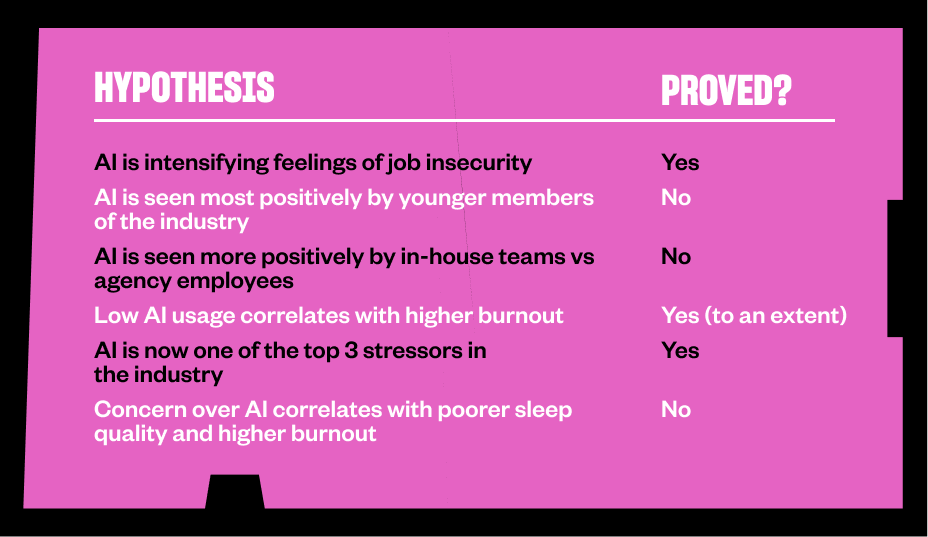
We entered with six hypotheses. Three proved correct, several surprised us – which is exactly why research matters.
“It’s killing and homogenising creativity, and young designers and creatives are racing towards it to further their careers and get ahead quicker. The basics are being lost and no one wants to learn and or work on the fundamentals”
Male, caucasian, 35-44, Australia
KEY DATA
• 3 of 6 hypotheses proved correct.
• Job insecurity intensified by AI: confirmed.
• Younger people are more positive about AI: not supported — 35–44 year olds are the heaviest users.
• In-house teams more positive than agency: not supported.
• Low AI usage correlates with higher burnout: partially supported.
• AI as a top-3 stressor: almost — it sits at #4 (pressure to keep up with AI/tech trends).
• Concern over AI does not correlate with poorer sleep or higher burnout.
Like any plan for good research, we entered this quest to find out what effect AI is having on our industry with some hypotheses based on conversations, anecdotes, industry commentary and Reddit opinion. In some cases our hypotheses were well founded, in others, we were surprised, but on further reflection able to better understand why we were incorrect.
The most important thing was to sort hyperbole from fact, fearmongering from day-to-day reality. Here's a summary of our findings.
More to come in our next post. Discuss the findings over in Slack.
Written by Kate Shelton and Andy Wright
.png)